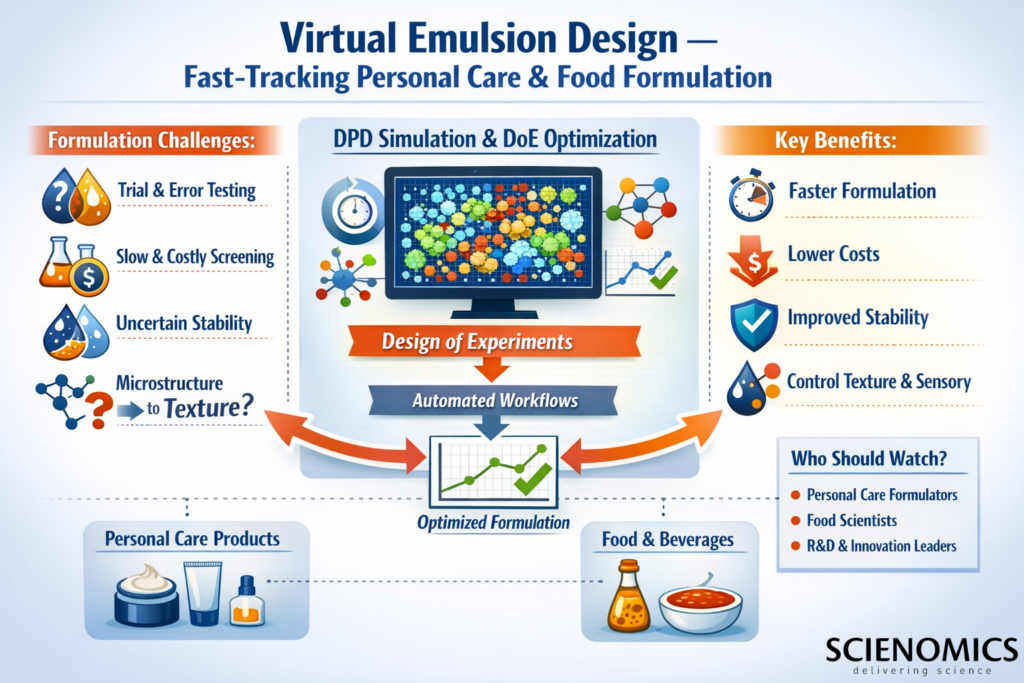
Emulsions are at the heart of many high-value products in personal care and food — from creams and lotions to sauces, dressings, and functional beverages. Yet optimizing stability, texture, sensory performance, and shelf life often requires extensive trial-and-error experimentation. In this webinar, we will demonstrate how materials simulations can act as virtual experiments to accelerate and de-risk emulsion development. Using Dissipative Particle Dynamics (DPD) simulations within Scienomics MAPS, we will show how formulators can model droplet formation, surfactant behavior, phase stability, and microstructure evolution at the mesoscale. These insights can then be integrated into a structured Design of Experiments (DoE) workflow to systematically optimize formulation parameters. We leverage the capabilities of Scienomics MAPS — a multiscale simulation environment that supports model building, simulation execution, and advanced analysis across quantum, classical, and mesoscale regimes. MAPS’ modular architecture enables seamless integration of mesoscale simulation engines (e.g., LAMMPS/DPD) and built-in analysis tools. MAPS unique Python-accessible workflow offers automation and customization for high-throughput virtual experimentation and dramatically reduces user effort and time-to-results. In today’s webinar you will see the benefits of
- Automated MAPS pipelines for high-throughput simulation sets
- Python scripting for custom protocol orchestration
- Post-processing of mesoscale data for DoE analytics
What We’ll Cover
1. Modeling Real-World Emulsions
- Surfactant and co-surfactant selection
- Oil phase screening (natural oils, silicones, triglycerides, flavor oils)
- Emulsifier performance and interfacial behavior
- Droplet size distribution trends and stability indicators
2. Turning Simulation into Actionable Design
- Using DPD outputs as quantitative inputs in DoE
- Reducing experimental screening space
- Identifying robust formulation windows
- Linking microstructure to texture, viscosity, and stability
Why This Matters for Personal Care
- Faster optimization of creams, lotions, and serums
- Improved sensory performance through better microstructure control
- Early-stage screening of alternative or sustainable ingredients
- Reduced instability risks (coalescence, creaming, phase separation)
Why This Matters for Food Formulation
- Improved shelf-life stability of sauces and dressings
- Optimization of mouthfeel and texture
- Efficient evaluation of plant-based emulsifiers and clean-label ingredients
- Reduced development cycles for functional and fortified products
Who Should Attend?
- Personal care formulators and cosmetic scientists
- Food scientists and product developers
- R&D managers in CPG companies
- Innovation and digital transformation leaders
The Takeaway
By combining DPD-based virtual experiments with Design of Experiments, you can move beyond empirical trial-and-error and adopt a more predictive, data-driven formulation strategy — accelerating innovation while reducing cost and risk.